- Family owned since 2011
Hail Damage Siding in Bismarck, ND: What It Looks Like, What It Costs, and How to Get It Covered
2,000+
Five-Star Reviews
5,000+
Projects Completed
15 Years
In Business
24/7
Emergency Response

The Silent Threat to Your Bismarck Home: Uncovering Hidden Storm Damage
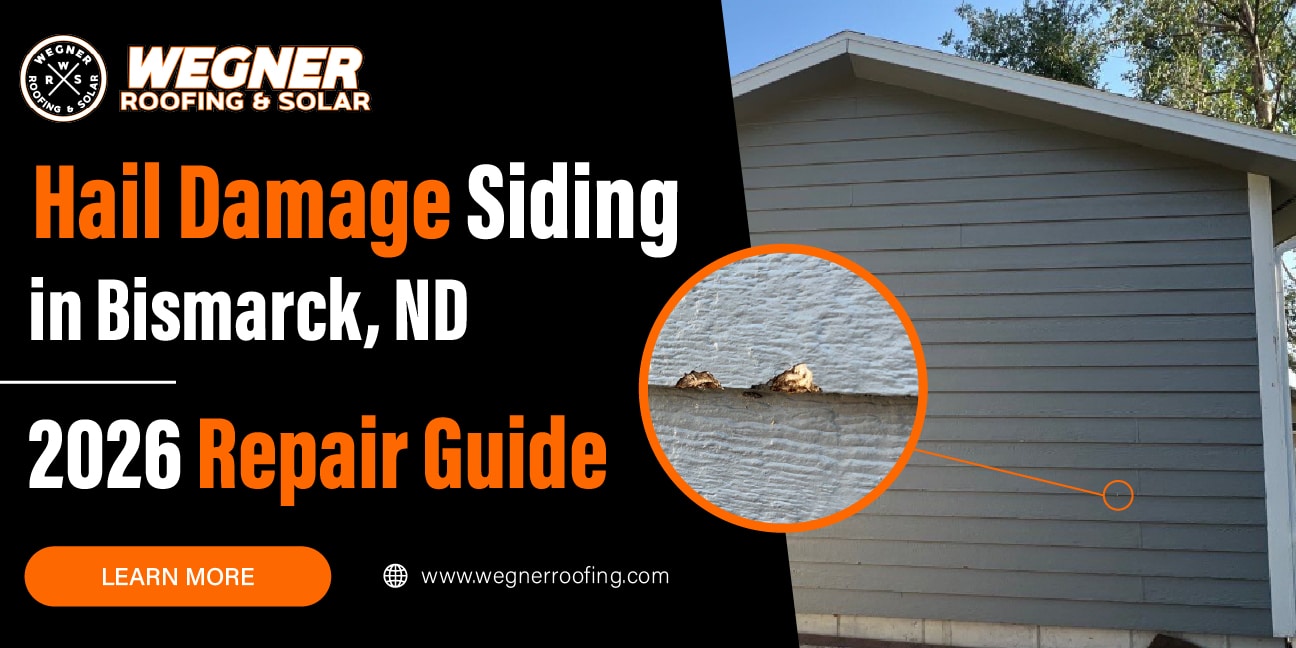
After a severe North Dakota storm, assuming your exterior survived untouched is a risky gamble. The reality is that hail damage siding issues in Bismarck are almost never visible from your driveway. We constantly see homeowners overlook the subtle signs until severe moisture rot sets in months later.
The destruction usually disguises itself as a hairline fracture near a nail head, a chalky dent, or a tiny coating chip. In this guide, we break down exactly what to look for on your specific material. We also explain how to ensure your insurance carrier covers the loss and when a simple repair makes more financial sense than a total replacement.
Insurance claim windows expire faster than most people realize. If a storm hit your neighborhood recently, waiting gives moisture more time to ruin your walls. Secure your spot on our inspection schedule today, and let Wegner Roofing & Solar protect your investment before your coverage deadline vanishes completely.
What Hail Damage to Siding Actually Looks Like in Bismarck
Recognizing hail damage in Bismarck depends heavily on your siding material. Missing these specific failure patterns could mean paying for a claimable loss out of pocket.
Vinyl Siding: Half-Moon Cracks
Standard vinyl typically cracks in a quarter-moon shape from angled impacts. These are structural breaks in your weather seal, not just cosmetic blemishes. Without a Class 4 impact rating, standard vinyl fractures easily from the 1- to 1.25-inch hail Burleigh County sees annually. Moisture will penetrate these cracks within a single freeze-thaw cycle.
Fiber Cement & LP SmartSide: Coating Damage
Unlike vinyl, fiber cement (James Hardie) and engineered wood rarely crack. Hail chips the factory coating instead, exposing the underlying substrate. You will notice small, light-colored dents with roughened surface textures. While they look minor on day one, these impact points become rapid moisture entryways by the next wet season.
Ground-Level Evidence
You do not need a ladder to spot the first warning signs. Inspect these items from the ground:
- Gutters & Window Wraps: Dented aluminum indicates hail strong enough to compromise your siding.
- AC Condenser Fins: Bent or flattened fins act as a highly reliable proxy for hail size.
- Mailboxes & Light Fixtures: Pockmarked metal facing the storm direction confirms your exterior’s exposure.
Check North and West Walls
Bismarck’s summer storms typically track from the northwest through the Missouri Valley. Always inspect your north- and west-facing walls first, as they absorb the most direct impact energy. Never assume your home is undamaged just because the southern or eastern walls look clean.
Wind Damage vs. Hail Damage: Bismarck's Two Different Siding Threats
These two damage types often arrive in the same storm, but they fail differently and insurance adjusters evaluate them differently.
How Straight-Line Winds Loosen Panels Before Hail Even Lands
High-plains wind gusts common to the Bismarck area put lateral pressure on siding panels, working at the interlocking seams until a panel edge loosens. Once a panel edge lifts even slightly, the next hail event drives moisture directly behind it rather than just chipping the surface. Wind damage is often the setup, and hail turns a loose panel into a documented loss.
Why Wind-Only Claims Get Scrutinized Harder Than Hail Claims
Hail leaves a physical impact signature that’s straightforward to photograph and measure. Wind damage, especially a single loosened or missing panel, is easier for an adjuster to attribute to installation age or wear rather than a specific storm date. If wind is your primary damage cause, timestamp your documentation the same day as the event, and note wind speed data from the National Weather Service Bismarck office for that date. That single piece of third-party data meaningfully strengthens a wind-only claim.
Which Siding Material Actually Survives Bismarck Hail
Not all siding performs the same way under impact, and the difference matters more in Bismarck than in most U.S. markets because of how frequently this corridor sees hail in the 1 to 1.75 inch range.
What a UL 2218 Class 4 Rating Really Tests
UL 2218 is the industry impact-resistance standard, developed in partnership with the Insurance Institute for Business & Home Safety, and Class 4 is its highest rating. To earn it, a product must withstand a 2-inch steel ball dropped from 20 feet directly onto the same spot twice without cracking or splitting. That’s a meaningfully higher bar than Class 1 through 3, and it’s why Class 4-rated products carry insurance premium discounts with most carriers writing policies in North Dakota.
Vinyl vs. Insulated Vinyl vs. Fiber Cement vs. LP SmartSide Under Impact
Material | Typical Hail Resistance | Insurance Premium Impact | Approx. Lifespan in ND Climate |
Standard Vinyl | Cracks at 1″-1.25″ stones | None (no Class 4 rating) | 20-30 years |
Insulated Vinyl | Resists cracking up to 1.5″ stones | Discount available on Class 4 SKUs | 25-35 years |
Fiber Cement (James Hardie) | Chips but rarely cracks through, best-in-class impact tolerance | Discount available, often the largest | 30-50 years |
LP SmartSide | Dents but holds coating integrity well | Moderate discount on rated products | 30-50 years |

The pattern here is consistent: the materials that survive Bismarck hail best also happen to be the ones that survive Bismarck winters best. Density and rigidity are doing double duty against both threats.
Is Hail-Damaged Siding Covered by North Dakota Homeowners Insurance?
Yes, hail is a named peril on most standard North Dakota homeowner policies. However, the critical factor is exactly how your policy calculates the payout.
Actual Cash Value (ACV) vs. Replacement Cost Value (RCV)
Payouts depend entirely on your coverage type. For an $18,000 claim, an Actual Cash Value (ACV) policy subtracts depreciation based on your siding’s age. If the siding is 12 years old, your check might only be $10,800. A Replacement Cost Value (RCV) policy ultimately covers the full $18,000.
Claiming Recoverable Depreciation
If you carry an RCV policy, that initial depreciation deduction is not permanently lost—it is considered “recoverable depreciation.” Once your contractor finishes the replacement and you submit a final invoice, you are entitled to a second check for the withheld balance (the remaining $7,200). Homeowners must actively request this payout; otherwise, thousands of dollars go unclaimed.
Strict Claim Deadlines
North Dakota claim filing windows are typically measured in months from the date of loss, not years. The most common reason legitimate claims go unpaid is undiscovered storm damage falling outside this strict timeframe. Always schedule a prompt exterior inspection after a hail event to secure coverage before your deadline expires.
How Siding Damage Gets Documented for a North Dakota Adjuster
Documentation quality determines claim outcome more than damage severity does. A thorough report on moderate damage often out-earns a thin report on severe damage.
The Test-Square Method, Applied to Siding Panels
Adjusters commonly use a marked test square, typically 10 feet by 10 feet, to count impact hits per area and establish a damage density baseline. On siding, this method gets applied wall-by-wall: a test square on the north wall, one on the west wall, with impact counts compared against the manufacturer’s damage threshold for that specific product. This wall-by-wall approach is what turns “some dents” into a defensible, quantified claim.
What to Photograph Before You Call Your Carrier
Photograph each damaged panel with a coin or ruler in frame for scale, get a wide shot of each affected wall showing damage distribution, and capture the ground-level evidence (gutters, AC fins, window wraps) mentioned earlier. Timestamp everything, ideally the same day you discover it.
When the Same Storm Hits Your Roof Too
If the storm that damaged your siding also damaged your roof, and in Bismarck this is common since both surfaces face the same weather event, you’re usually better served filing one combined claim rather than two separate ones. Our team handles storm damage roof repair and siding damage under a single inspection and a single report whenever both are affected. For a deeper walkthrough of the roof-side claim mechanics specifically, our guide on Bismarck hail damage from inspection to insurance covers that process in detail, and if wind was the dominant factor in your storm, our Bismarck wind storm roof insurance claim guide breaks down how wind-specific claims get evaluated differently from hail claims.
Repair or Replace? A Decision Framework for Hail-Damaged Siding
Deciding whether to repair or replace hail-damaged siding depends on three crucial factors: damage distribution, panel availability, and underlying moisture.
When Localized Repair Makes Sense
If damage is strictly isolated to a single wall, your siding is under ten years old, and the manufacturer still produces your exact color, a targeted repair is usually the honest answer. This scope of work typically costs a few hundred to a low few thousand dollars.
When Replacement is the Smarter Math
Full replacement is the better financial decision when damage spans multiple walls or matching panels are discontinued. Furthermore, if moisture has already reached the wall sheathing, full replacement is mandatory. If insurance is paying for the loss, the marginal cost difference between a massive repair and a total replacement shrinks significantly. Bismarck replacements generally range from $12,000 to $35,000.
Navigating City Permits
Bismarck classifies full siding replacements as residential alterations, requiring specific permits separate from roofing. At Wegner Roofing & Solar, pulling these permits is a standard part of our scope. To see how we protect local homeowners during this process, visit our Google Business Profile to read our latest customer reviews.
Case Study: A Hay Creek Home After a Missouri Valley Hailstorm
A homeowner near the Hay Creek area called after a June storm left visible damage on their asphalt roof, but they hadn’t thought to check their siding. During the same-day inspection, our team found 14 impact points on the west-facing vinyl siding, none visible from the street, all consistent with hail in the 1.25 inch range recorded by the local weather station that same afternoon.
Because the roof and siding damage came from the identical storm event, we documented both under one inspection report and one insurance claim. The homeowner’s policy was RCV with a 10-year-old siding install. Their first check reflected ACV, and once the replacement was complete, the recoverable depreciation check followed within a few weeks of submitting the final invoice. Total combined settlement covered roughly 90% of the full roof-and-siding project cost. The homeowner’s own words when we finished: they had no idea the siding was even damaged until we pointed out the pattern on the west wall.
That’s the recurring lesson in Bismarck claims: the damage that costs you money is almost always the damage you didn’t know to look for.
Bismarck-Mandan Neighborhoods Where We See the Most Hail-Damaged Siding Calls
South Bismarck and the Kirkwood Mall Corridor
South Bismarck homes along the Kirkwood Mall corridor and into the Northridge area sit directly in the path of storms tracking up from the southwest, and we see a disproportionate share of west-wall siding damage calls from this part of the city each spring.
Mandan’s River Valley Wind Exposure
Cross the Missouri River into Mandan and the wind exposure changes noticeably. River valley properties take sustained gusts that Bismarck’s more built-up neighborhoods are partially shielded from, which means older vinyl siding in Mandan tends to show wind-related seam separation even in storms that produce only moderate hail.
Lincoln, Wilton, Washburn, Hazen, and Rural Burleigh County
Lincoln’s newer construction southeast of Bismarck generally has more recent siding installs, but that doesn’t make it immune. Heading north along Highway 83 into Wilton and Washburn, and west toward Hazen, rural properties and outbuildings face the same storm systems with less tree cover to soften impact. Farmhouses and detached shops in these areas take hail identically to in-town homes. As premier siding contractors in Bismarck, ND, we service the full radius from our Wegner Roofing & Solar location on Airport Road out through all of Burleigh County.
Frequently Asked Questions
What does hail damage to siding look like?
Hail damage on vinyl siding appears as curved, half-moon-shaped cracks near panel edges or nail points, while fiber cement and LP SmartSide typically show small dents with chipped or roughened coating. Damage concentrates on north- and west-facing walls in most Bismarck storms and is often invisible from ground level until inspected closely.
Will insurance pay to replace siding hit by hail?
Yes, in most cases, since hail is a named peril under standard North Dakota homeowner policies. Payout amount depends on whether your policy is Actual Cash Value or Replacement Cost Value, and whether the damage is documented and filed before your claim window closes.
Can hail-damaged siding be repaired instead of replaced?
Yes, when damage is limited to one wall or a small number of panels, the siding is relatively new, and matching replacement panels are still available from the manufacturer. Widespread damage, moisture intrusion, or discontinued panel colors typically make full replacement the better decision.
Which siding survives North Dakota wind and hail best?
Fiber cement (James Hardie) generally offers the best combined hail and wind performance of any siding material available in Bismarck, followed closely by LP SmartSide and Class 4-rated insulated vinyl. Standard vinyl without an impact rating is the most vulnerable of the four common options.
How is siding damage documented for an adjuster?
Adjusters use a marked test square method, counting impact hits per defined wall area and comparing that density against manufacturer damage thresholds. Homeowners should photograph each damaged panel with a scale reference, capture wide shots of each affected wall, and timestamp everything the same day damage is discovered.
Get Your Siding Damage Documented Before the Claim Window Closes
Ignoring hail damage siding issues will not make them disappear; it only makes them more destructive. As hidden moisture quietly rots your walls and your strict insurance claim deadline rapidly approaches, waiting is a financial risk you simply cannot afford. Documenting storm impact immediately is the only way to truly secure your property.
At Wegner Roofing & Solar, we know exactly how overwhelming storm recovery feels. We lift that burden off your shoulders by inspecting your entire exterior, compiling a detailed report, and managing the complex insurance conversation on your behalf. Do not let your rightful coverage expire. Request an estimate on our siding services page today.
Get Your Free Estimate